Personality and career test methodology
Cognitive abilities task set
Created based on the knowledge of cognitive psychology science. The study of individual differences in abilities is an important part of this science. Human intelligence can be described both by a single measure of general abilities and by dividing this measure into separate areas – so-called cognitive abilities. The Spotiself test is based on this understanding of the structure of intellectual abilities, so it calculates both general abilities and aspects of memory, cognitive speed, verbal and non-verbal thinking. The reliability and validity of the cognitive abilities task set are based not only on theoretical but also practical calculations. After a large pilot study, it was found that the tasks are reliable – this means that the test reveals not a random score, but one characteristic of the individual being tested. It was also found that the tasks are related to each other in theoretically expected directions and strengths, so the test is valid. Moreover, the results of this test are closely related to students' academic achievements. In summary, the test reflects the true abilities of the person.
Personality traits questionnaire
Created based on the currently most popular and scientifically supported personality theory – the Big Five or Five Factor theory. This theory, which gained most support in the late 20th century, states that human personality can be described by five major traits – extraversion (related to the need for social interaction, energy, etc.), emotional stability (related to the frequency of experiencing negative emotions, ability to cope with stress), openness to experience (related to curiosity, preference for novelty), agreeableness (related to altruism, helping others, etc.), and conscientiousness (related to goal setting, planning, etc.). The test questions were created and selected to reflect these five traits. During the main study, using a special mathematical technique – factor analysis – it was confirmed that the questions indeed form five traits, thus confirming the test's validity. Additionally, this study provided evidence that the personality traits questionnaire is also reliable.
Professional interests questionnaire
It was created by analyzing the professions currently existing in the labor market and the specialties available at universities, colleges, and vocational schools. The questions were selected to reflect not only interests and engagement in different professions but also the skills required for them. Such a questionnaire structure allows for a deeper understanding of one's professional abilities. After conducting research and applying the aforementioned factor analysis, seven types of professional interests were identified. These types essentially correspond to the classic J. Holland theory of professional interests but better reflect the realities of today's world of professions—the normative type associated with clerical professions was not distinguished, while the social type related to helping people was divided into separate types associated with medical and social professions.
Created in collaboration with scientists

Dr. Antanas Kairys
Associate Professor of Psychology, VU
Professor at the Institute of Psychology at Vilnius University, researching lifelong career development, personality traits, and social functioning. Antanas Kairys develops and adapts personality, career, well-being, and other tests (NEO PI-R, NEO - FFI, LPGS, etc.). Author and co-author of numerous scientific articles, books, and presentations at international and national conferences. Actively provides recommendations for shaping social and education policy, and communicates psychology research achievements in the media.

Dr. Vytautas Jurkuvėnas
Associate Professor of Psychology, VU
Associate Professor of Psychology, conducting research in human cognitive functions (e.g., memory, attention, executive functions) and their relationships with psychological and health factors. His work includes the development and adaptation of psychological tests, assessment of psychometric properties, standardization, and norm creation, as well as the application of computerized tasks (e.g., PEBL and other testing platforms) in research and practice. Actively publishes scientific articles, participates in international and Lithuanian scientific conferences, and contributes to student teaching and supervision of scientific work.
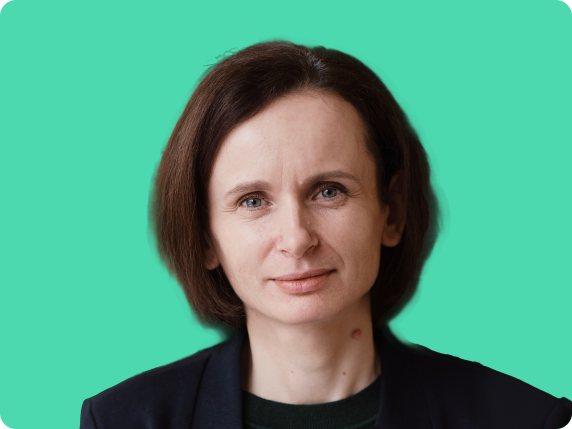
Dr. Ieva Urbanavičiūtė
Associate Professor of Psychology, VU
Associate Professor at Vilnius University's Institute of Psychology, specializing in work and career psychology, and an associate member of University of Lausanne's Career Psychology and Vocational Guidance Research Center. Her research interests include improving the quality of psychosocial working conditions, stress management, and the career development characteristics of young people and adults. She participates in various national and international research projects, teaches research methodology, career development, and organizational psychology courses, and is a co-author of numerous scientific publications.
Education for career activities justification
Learning through experience and meaning-making
Educational activities are constructed based on the premise that students should thoroughly explore career topics and related life situations: raise problematic questions, collect and evaluate information, try alternatives, experience consequences in a safe learning environment, and reflect on the meaning of their choices. This experiential-constructivist approach aligns with classical educational philosophy, emphasizing learning through experience and active meaning-making, as well as the philosophy of deep learning, highlighting the synergy between teaching content and everyday life. Sources: Dewey (1938); Fullan & Langworthy (2014); Egan (2014); Pollard (2006).
Motivation and engagement
Conditions are deliberately created in activities to support student autonomy, competence experience, and relatedness, as these factors strengthen intrinsic motivation, enjoyment of learning, engagement, and responsibility for one's own learning. Sources: Ryan & Deci (2017).
Competency-based education
The content and expected outcomes of educational activities are based on competency-based education and updated general education content: each activity specifies how the student will demonstrate growth in cognitive, communication, creativity, citizenship, social-emotional, cultural, and digital competencies, integrating knowledge, skills, and attitudes. This aligns with international competency frameworks emphasizing student agency and the ability to act in a changing world. Sources: OECD (2019).
Critical thinking and reflection
Competency-based career education is implemented using a critical thinking framework: engagement (activation) → meaning-making → reflection. This structure helps students justify their decisions, analyze contradictions, identify assumptions, and monitor and evaluate their reasoning (metacognition).
Contemporary career development models
Career education content is based on contemporary career development models: career construction and identity creation, social-cognitive approach (self-efficacy, goals, contextual factors), and planned happenstance logic, which helps students learn from real opportunities and unexpected experiences. This is manifested through self and environmental awareness, communication and collaboration, 'self' creation, expression of thoughts and feelings, and acting in authentic situations. Sources: Savickas (2019); Lent & Brown (2019); Krumboltz (2009).
Technology as a tool: for inquiry, co-creation, and evidence collection
Technology is used not as a form, but as a means for inquiry, co-creation, feedback, and collecting evidence of student achievements (competency portfolio). This reflects the logic of technology integration, where technology is consistently combined with pedagogy and educational content. Sources: Mishra & Koehler (2006).
Created in collaboration with researchers
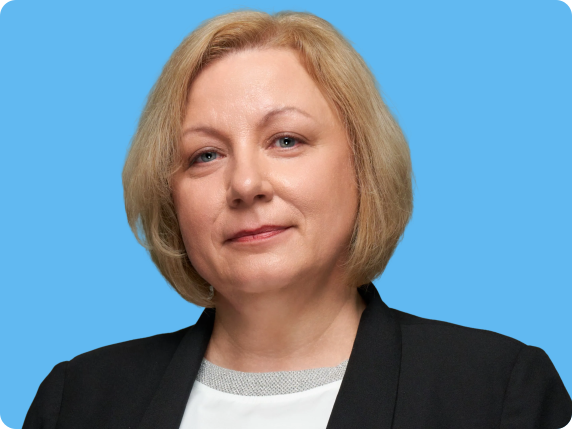
Dr. Asta Railienė
MRU professor, Modern Didactics Centre expert
Educologist and researcher working in the fields of career education, critical thinking development, educational support, and teacher training. Conducts research on educational support in school communities, career education, critical thinking development practices, and challenges in teacher training. She is a career education expert, author of scientific publications, methodological tools, and professional development programs. She consults school communities on providing career services to students and contributes to the professional development of educational support and career specialists.
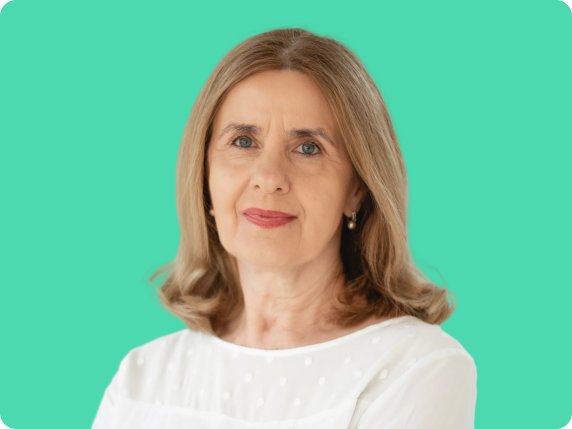
Dr. Daiva Penkauskienė
MRU associate professor, Modern Didactics Centre director
Head of the Center for Contemporary Didactics, educologist, associate professor at Mykolas Romeris University. Areas of expertise include didactics, critical thinking development, teacher training, and professional development. Conducts research on critical thinking development and innovative teaching and learning methods. She is an expert in critical thinking development, author of scientific publications, methodological tools, and professional development programs. She consults school communities on critical thinking development and didactics, contributes to the professional development of educational support and career specialists, and is a board member of the Lithuanian Educational Research Association (LETA).